Explore the options
Five separate advisors receive the same brief. Each uses a different lens to test assumptions, objectives, upside, clarity, or feasibility.
Examine decisions about pricing, hiring, product direction, operations, or technology through five advisor perspectives, blind review, and a chair’s recommendation.
Use one supported AI assistant with subagent capabilities. The whole council can run with one model in that assistant. “Portable” means you can choose your environment; you do not need multiple subscriptions.
Adapters for Claude Code, Codex, Cursor, Command Code, Grok Build, OpenCode, and Factory Droid.
See how it works ↓Each round has a different job: explore, challenge, then decide.
Five separate advisors receive the same brief. Each uses a different lens to test assumptions, objectives, upside, clarity, or feasibility.
Five fresh reviewers assess the complete anonymous answers in different orders. They identify strong reasoning, blind spots, and anything the answers collectively missed.
A separate chair weighs the answers and reviews, explains disagreements, and recommends a course of action. Strong reasoning can outweigh the majority.
Which assumption is most vulnerable?
What are we actually trying to achieve?
What upside are we overlooking?
What is unclear or taken for granted?
What can we do with the resources available?
See what the council recommends, why it recommends it, and where the advisors disagree.
Use the report to question the assumptions behind the recommendation, identify what still needs checking, and decide whether the proposed next step fits your circumstances.
The transcript lets you revisit the individual answers and reviews when you want to understand how the recommendation was reached.
See it applied to a decision ↓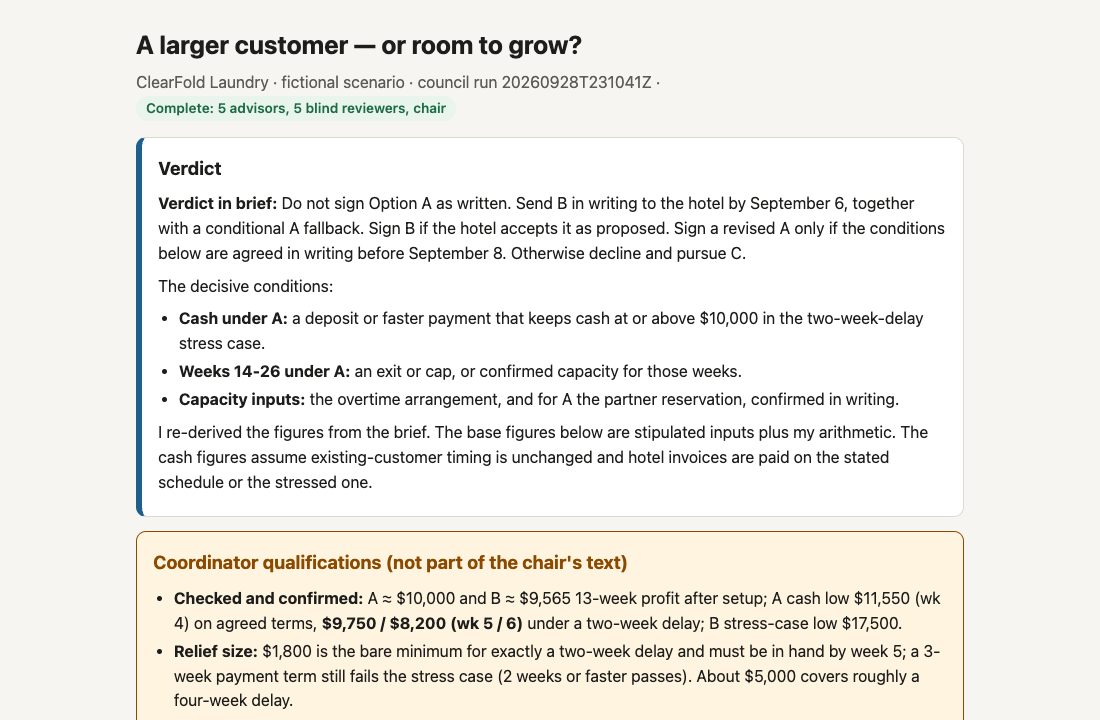
An actual Claude Code run using one model. Read the example’s limits alongside it.
A commercial laundry owner weighs a large hotel contract against cash needs, peak capacity and existing customer commitments.
The council recommended seeking a smaller allocation, with a conditional full-contract fallback. Its central finding: a profitable contract can still leave the business short of cash.
This fictional scenario was evaluated in an actual council run. It illustrates the process, not a verified business outcome.
Explore the complete brief, recommendation, and review notesThe council is intended for consequential business and technical decisions: product direction, pricing, hiring, positioning, or an implementation strategy.
Give it your objective, alternatives, constraints, evidence, and important unknowns. Those details give each perspective something concrete to examine.
For routine questions, a direct answer may be enough. When a small experiment can resolve the uncertainty, that experiment may be the more useful next step.
Different perspectives do not create independent factual evidence. Agreement does not establish truth, and anonymous labels cannot conceal every stylistic clue.
A full council uses 11 agent runs, which can take more time and tokens than a direct answer. Results depend on the model, the decision brief, and the AI assistant’s ability to maintain separate worker contexts. If a required round cannot finish, the result should be marked incomplete.
Portable LLM Council combines one shared skill with native agent definitions for Codex, Cursor, Command Code, Grok Build, OpenCode, Factory Droid, and Claude Code.
The shared skill defines the method. The native definitions provide the advisor, reviewer, and chair roles for your AI assistant. Together, they make the workflow reusable without having to assemble each assignment yourself.
Choose your AI assistant, follow its installation guidance, and verify discovery before your first run.